
Eighty-one years ago today, at 11.01pm Central European Time, the Second World War in Europe came to an end. More than 10 million members of the Allied armed forces — above all the Red Army — had fallen before the German Wehrmacht was forced into unconditional surrender. The act of surrender had already been signed on 7 May 1945 in Reims, at the Supreme Headquarters of the Allied Expeditionary Force; at Soviet insistence, it was repeated during the night of 8 to 9 May at the Red Army headquarters in Berlin-Karlshorst. Even this historical detail suggested that military victory could end the war, but not establish a viable global peace order. What followed was an ideologically divided postwar settlement, which after the Cold War seemed only briefly to consolidate into a broadly liberal world order and is now being challenged at its core by geopolitical realignments.
The significance of 8 May therefore reaches far beyond Germany’s military defeat. The date marked the collapse of a criminal regime that had brought war to Europe, planned, organised, and carried out the Shoah, persecuted, enslaved, and murdered millions, waged a racist war of conquest and annihilation, and systematically destroyed law, human dignity, and political reason. That defeat marked the end of the most murderous culmination of a longer prehistory of völkisch nationalism, fascism, and National Socialism — of political movements and ideologies that despised democracy, glorified violence, ranked human beings by origin and ‘race’, and replaced international order with imperial claims to power. What led to the Second World War in 1939 was not a historical accident, but the consequence of political disinhibition: law was replaced by power, democracy by the Führer cult, and international order by imperial expansion. By the end, the Second World War had cost more than 60 million lives.
For the persecuted, enslaved, and disenfranchised in the collapsing German Reich, and in the territories previously occupied and terrorised by Germany, this day sealed the end of National Socialist tyranny. For a Germany on the brink of division, it became an unavoidable confrontation with guilt, responsibility, and the question of whether, after moral, political, and material collapse, a democratic new beginning would be possible. Federal President Richard von Weizsäcker captured this tension in his speech of 8 May 1985 in a formula that remains authoritative: ‘8 May was a day of liberation.’ He did not mean liberation from German responsibility, but liberation ‘from the inhuman system of National Socialist tyranny’. At the same time, Weizsäcker named Germany’s historical responsibility with great clarity: ‘We must not separate 8 May 1945 from 30 January 1933.’ For National Socialist rule had not simply descended upon Germany. It was made possible by the crisis of the Weimar Republic, the erosion of its democratic centre, Heinrich Brüning’s deflationary crisis policy from 1930 to 1932 and his rule by emergency decree, the rise of ethno-nationalist and anti-democratic movements — and finally by the transfer of power to Hitler by national-conservative élites around Hindenburg and von Papen. The day was therefore no simple triumph. Homecoming, flight, violence, homelessness, liberation, captivity, loss, grief, relief, and new beginnings lay close together.
It is precisely here that its enduring political significance lies. The date permits no comfortable remembrance. It points to German guilt, to liberation from a regime that could only be broken militarily from outside, and to the question of what kind of order had to be built from such a catastrophe. After 1945, the task was not reconstruction alone. It was to contain the forces that had twice led Europe into the abyss: völkisch nationalism, authoritarian ideology, economic destabilisation, imperial revision, and brutal power politics that disregarded international law, state sovereignty, and the security of smaller states.
That question now returns with new urgency. Russia is openly attacking the European postwar order with imperial violence. At the same time, nationalist and illiberal forces are gaining power within western democracies: forces that regard multilateral institutions, legal obligations under international law, and rules-based co-operation not as prerequisites of shared security, but as constraints on national freedom of action. This shift is particularly consequential in the United States under President Donald Trump. The 2025 National Security Strategy (NSS) sets out this policy change in programmatic form. On Europe, it rejects the current course of European integration and offers as its counter-image ‘a group of aligned sovereign nations’. At the same time, it announces support for ‘resistance to Europe’s current course’ within European states and calls for the restoration of strategic stability with Russia, the aggressor in the war against Ukraine. These strategic aims show that ‘aligned’ here does not merely mean alignment among sovereign partners, but implies Europe’s political orientation towards American priorities. They mark a clear departure from Washington’s earlier self-understanding as guarantor of a rules-based European security order and a turn towards power politics that recognises rules only selectively — or circumvents them altogether.
Politically, this amounts to an image of Europe in which the European Union appears less as an integrated supranational actor capable of acting in its own right than as a fragmented association of nationally oriented states following American priorities. This understanding celebrates sovereignty as liberation from Brussels, but leaves Europe more vulnerable to Washington. The more fragmented Europe is, the easier it becomes to discipline individual governments through security guarantees, troop deployments, tariffs, or market access — according to the old logic of divide and rule. The rhetoric of sovereignty would thus turn into a logic of political dependency, at the extreme a new form of vassalage. In doing so, the NSS consciously connects with the ideas of those nationalist-right to far-right party families in the European Parliament that it positively frames as ‘patriotic’ forces and whose growing influence it describes as a ‘cause for great optimism’. These are the Europe of Sovereign Nations group, which includes AfD members, the European Conservatives and Reformists around PiS and Fratelli d’Italia, and Patriots for Europe around Rassemblement National and Fidesz. Together, these groups account for roughly a quarter of the members of the European Parliament. In individual votes on migration and on environmental and corporate rules, they have already formed alternative majorities with the moderate-conservative European People’s party. This weakens the cordon sanitaire that was meant to prevent far-right and nationalist forces from again exerting decisive influence over Europe’s political course.
That is why the date leads beyond remembrance to the question of order. The postwar international and European order — beginning with Bretton Woods in 1944, then the United Nations in 1945, and the European Coal and Steel Community in 1951 — arose from the experience that peace does not emerge from mere exhaustion after war. It has to be built institutionally, secured legally, underpinned economically, and defended politically.
Patterns of ruptured order
History does not repeat itself mechanically. But it does reveal recurring patterns. Europe’s great wars — the Thirty Years’ War, the Napoleonic wars, the First World War, and the Second World War — were each culmination points of deep crises of order: confessional division, revolutionary upheaval, dynastic and imperial rivalry, radicalised nationalism, ideological disinhibition, and power politics without sufficient legal restraint. After the devastation came attempts to contain the destructive logic of unrestrained power through new orders: the Peace of Westphalia, the Congress of Vienna and the Concert of Europe, the Treaty of Versailles and the League of Nations, and finally the multilateral system that arose after 1945 around the United Nations, Bretton Woods, and European integration.
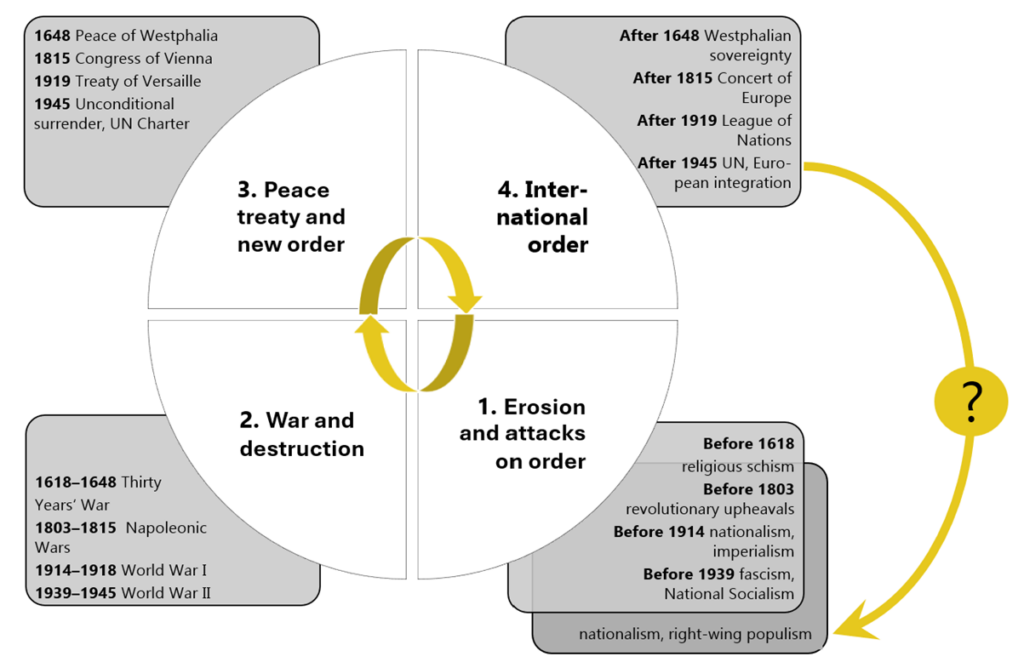
As early as 1795, in his essay Perpetual Peace, Immanuel Kant addressed this historical pendulum movement between the construction and collapse of order. He wrote in the shadow of the French Revolution, the European coalition wars, and an order of states in which war, dynastic power politics, and the territorial disposal of states were treated as normal instruments of politics. His alternative vision, rooted in arguments he had developed over more than a decade, was directed against the realpolitical assumption that security ultimately arose from political power, tactical alliances, and military superiority. Against this, Kant formulated a radical claim about order: peace does not arise from exhaustion, but from the legal overcoming of the international state of nature — from the reasoned insight that states must ‘leave the lawless condition of savages and enter into a federation of peoples’ (Kant, 1784). States must bind their power by law, rather than deriving security solely from their own strength, alliances, and military superiority.
Before Kant formulates the positive foundations of a lasting order of peace, he names, in his preliminary articles, those practices that structurally undermine peace: secret reservations in peace treaties for future wars; treating states as if they were possessions; permanent militarisation; debt-financed power politics; violent interference in the constitution of other states; and practices of war that destroy any later trust. These warnings are not an antiquarian footnote. They show that, for Kant, peace does not begin with the signing of a treaty, but with the political self-restraint of states.
Kant’s (1795) idea of peace rests on three conditions: first, republican constitutions, which in modern terms stand opposed to absolutist rule and imply democratic constitutionalism; second, a federation of free states that legally contains the international state of nature; and third, in modern liberal interpretation, a form of cross-border economic interdependence that turns rules-based free trade, low trade barriers, and multilateral trade law into conditions for positive-sum exchange, making war politically and economically less rational. In modern liberal international relations theory, Kant thus became the point of departure for a peace triangle of democracy, institutional binding, and economic interdependence. In Kant himself, however, the third element is not free trade, but cosmopolitan right: the legal limitation of state arbitrariness also in its treatment of strangers.
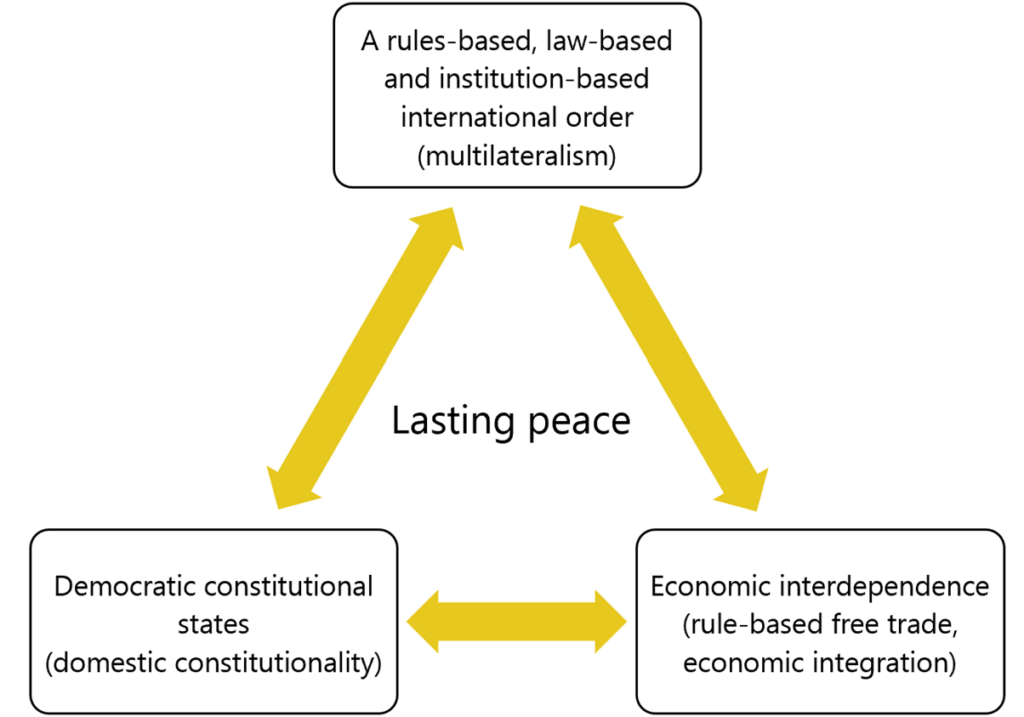
To this day, these three elements form the core of the liberal international order. It rejects the power-political logic of zero- and negative-sum games and holds to the possibility that co-operation, institutions, law, and economic interdependence can generate positive-sum outcomes. It was precisely this threefold structure that, after 1945 — imperfectly, constrained by power politics, but with historic effect — took institutional form in the United Nations, Bretton Woods, and European integration.
The fact that this order is now under pressure turns the date from a mere occasion of remembrance into a political warning. Russia’s war of aggression against Ukraine, the US-Israeli war against Iran, the return of great-power rivalry, global rearmament, energy coercion, deglobalisation, protectionism, and the illiberal assault on democratic norms and multilateral institutions raise the question of whether we are risking the very foundations on which Western Europe’s postwar peace and prosperity, at least, have rested. The present is not a repetition of the past. But it shows once again how vulnerable any order becomes when nationalism, authoritarian power politics, economic insecurity, and disregard for law begin to reinforce one another — the very constellation that has repeatedly led Europe into conflict, war, and catastrophe.
Peace is a legal condition
For precisely this reason, Kant is more relevant today than may first appear. His concept of peace does not merely denote the absence of open hostilities. For Kant, peace is a legal condition that must be established and preserved. It requires that power not have the final word, that borders not become disposable assets, that treaties create trust, and that security not be derived solely from threat, rearmament, and alliance arithmetic. Kant’s preliminary articles therefore read like a counter-catalogue to the present destruction of order: against secret reservations for future wars, against treating states as possessions, against permanent militarisation, against debt-financed power politics, against violent interference in the constitutional order of other states, and against practices of war that make later trust impossible.
It is precisely at these points that today’s crisis becomes visible. With its war of aggression against Ukraine, Russia violates the basic principle of territorial integrity and seeks once again to shift borders by force. Nuclear threats, attacks on civilian infrastructure, deportations, disinformation, and the systematic destruction of trust damage the preconditions of any future European security order. A peace settlement that rewards aggression or retrospectively normalises territorial revision would therefore not be a Kantian legal condition, but a ceasefire with the next war built into it.
The standard, however, applies more broadly. In Gaza, Hamas’s targeted attacks on civilians and the taking of hostages, as well as Israel’s conduct of war — marked by a logic of military retribution, displacement, the extensive destruction of civilian infrastructure, and the starvation of the civilian population through blocked or restricted access to humanitarian assistance and essential goods — undermine trust in the binding force of international humanitarian law. In the war against Iran, the question arises whether pre-emption and deterrence remain legally contained or slide into a logic of regional escalation, strategic dominance, and militarised trade and energy routes. In all three cases, the lesson is the same: where violence is no longer limited by law, proportionality, and trust, it is not only a single conflict that is aggravated. The possibility of a durable condition of peace is damaged.
The crisis thus runs through all three sides of the Kantian peace triangle: the international legal and institutional order, democratic constitutionalism at home, and economic interdependence. First, the international legal and institutional order is losing binding force. The Security Council is blocked by veto politics; the global trade order is being placed under pressure by tariffs, sanctions, subsidies, and geo-economic bloc formation; international courts and human rights norms are recognised selectively; and multilateral institutions are caught between authoritarian revisionism, western double standards, and growing scepticism in the global south. The problem is not that power politics has returned. It never disappeared. The problem is that more and more states accept rules only when they serve their own strategic interests.
Where external rule-binding erodes, internal restraints on power become decisive. That is why the democratic side of the peace triangle is not merely domestic politics. Kant placed his hopes in republican — that is, non-monarchical and non-absolutist — constitutions because governments accountable to their citizens cannot so easily wage war as a dynastic or imperial instrument. In modern terms, this means that democratic constitutional states, separation of powers, a free public sphere, and institutional trust are not domestic side issues, but conditions of the capacity for peace abroad.
In Europe, this condition is becoming more fragile. When far-right and nationalist forces no longer merely organise opposition to European integration, but in individual votes form majorities with the moderate-conservative centre — for example on the returns regulation or on the weakening of sustainability and due-diligence obligations for companies — the democratic centre of gravity of European politics shifts. International commitments then more readily appear as betrayals of national sovereignty, minority protection as weakness, independent media as enemies, and compromise as capitulation. Where illiberal forces weaken parliaments, delegitimise the media, attack minority rights, and portray international obligations as shackles on national power, foreign policy too becomes more vulnerable to friend-versus-enemy thinking, authoritarian admiration, and strategic unpredictability.
Finally, economic interdependence — the remaining dimension of the Kantian peace triangle — is also under pressure. The liberal idea was never that trade alone guarantees peace. It was that rules-based interdependence binds interests together in such a way that co-operation becomes more rational than war. The energy crisis, however, has shown how dangerous interdependence becomes when it is asymmetric, opaque, and politically vulnerable to coercion. Europe’s dependence on Russian energy was not a peace dividend, but a strategic vulnerability. Today, the same logic is reappearing in other sectors: in American tariff threats against European cars, as well as in Chinese export controls on rare earths, which are indispensable for digital, green, and defence-industrial value creation. What was meant to create prosperity through mutual interdependence becomes a weapon under conditions of geopolitical rivalry.
International politics is thus shifting back towards the zero- and negative-sum games that liberal internationalism sought to overcome. Security is understood as a relative gain against others; trade as a weapon, energy as a lever of pressure, technology as a frontier of bloc politics, migration as an instrument of domestic mobilisation, and development policy as a geopolitical transaction. How far this logic has already penetrated economic strategy debates is shown by Stephen Miran’s (2024) guide to ‘restructuring the global trading system’: tariffs, currency policy, reserve-currency status, and security guarantees no longer appear primarily as elements of a rules-based positive-sum order, but as levers to renegotiate burden-sharing, industrial reallocation, and strategic allegiance. In such a world, mistrust, rearmament, and closure feed one another. That is the danger: the peace order is not destroyed by one conflict alone, but by the simultaneous erosion of its preconditions.
Realism rightly reminds us that institutions without a power base remain hollow. The League of Nations did not fail for lack of moral rhetoric, but because it lacked membership, power, the willingness to impose sanctions, and the capacity to overcome national self-interest. Liberalism, however, is equally right to remind us that power without legal restraint creates no stable order. Deterrence can prevent aggression; it cannot replace a legal condition. Trade can create prosperity; it cannot replace rules. Sovereignty can protect freedom; it becomes dangerous when understood as a licence against all binding obligations.
Signs of a rupturing order
The diagnosis is not abstract. Several indicators show that the erosion of the postwar order is unfolding simultaneously in security, economic, and institutional terms. Russia’s war of aggression against Ukraine is the clearest European rupture. It is directed not only against the sovereignty of one state, but against the basic principle that borders in Europe must not be changed by force. The accession of Finland in 2023 and Sweden in 2024 to Nato is therefore more than a footnote in alliance politics. It marks the return of existential security anxiety in Europe and the end of a long phase in which many believed military deterrence could permanently recede behind economic interdependence. It is not yet possible to foresee the consequences of the US-Israeli war against Iran.
Globally, too, the indicators point in a dangerous direction. The Uppsala Conflict Data Program registered 61 active conflicts worldwide in 2024 involving at least one state as a conflict party — the highest number since records began in 1946. The Stockholm International Peace Research Institute reported in its 2026 survey that global military expenditure in 2025 stood at 2.9 trillion US dollars, measured in constant 2024 US dollars. In real terms, this represented an increase of 2.9 per cent compared with 2024; the rise was particularly marked in western and central Europe, which after the end of the Cold War had long counted on a lasting peace dividend. There, expenditure rose by 15.8 per cent over the same period. Freedom House recorded in 2025 the twentieth consecutive year of global decline in political rights and civil liberties — with marked deterioration also in the United States. Security, democracy, and the binding force of international rules are therefore not eroding separately. They are coming under pressure at the same time.
The energy crises of recent years — triggered by Russia’s war of aggression against Ukraine and intensified by the US-Israeli war against Iran — have further shown that interdependence promotes peace only under certain conditions. Economic interdependence can stabilise when it is reciprocal, diversified, transparent, and rules-based. It becomes dangerous when it is asymmetric and politically susceptible to coercion. In retrospect, Europe’s dependence on Russian energy was therefore not merely an economic error, but a strategic misjudgement: the assumption that cheap Russian gas could simultaneously support security of supply, industrial competitiveness, and a predictable energy transition proved strategically vulnerable. The European Commission states that the share of Russian gas in EU gas imports has fallen since the start of the war from 45 per cent to 12 per cent in 2025; Russian coal imports have been sanctioned, and oil imports have been sharply reduced. The lesson is not autarky, but resilient openness: climate protection, security of supply, industrial competitiveness, and geopolitical agency must in future be understood as parts of the same peace policy.
Economically, too, the postwar logic is being challenged. Bretton Woods rested on the experience that financial crises, hyperinflation, mass unemployment, and protectionism can destabilise democracies and strengthen authoritarian movements. That experience has not been consigned to history. In its April 2026 World Economic Outlook, the IMF warns of slowing global growth, renewed inflation risks, geopolitical fragmentation, trade tensions, high debt levels, and difficult trade-offs arising from increased defence spending. A problem of the interwar period is thus returning in a new form: when economic insecurity is experienced as a loss of control, nationalist and protectionist answers gain appeal.
Bretton Woods was therefore more than a monetary architecture. It was an attempt to take macroeconomic instability seriously as a risk to peace: currency crises, competitive devaluations, mass unemployment, and protectionism were not to be allowed again to nourish the political radicalisation that had destroyed the interwar period. Despite the substantial differences between Harry Dexter White, the formative architect of the American position, and John Maynard Keynes, the leading figure of the British delegation — as Benn Steil reconstructs in The Battle of Bretton Woods — the agreement institutionalised a new form of international economic co-ordination. Through fixed exchange rates, capital controls, and the gold-linked US dollar as anchor currency until the early 1970s, monetary order, reconstruction, and economic stability became supporting elements of the peace architecture, embedded in multilateral institutions, especially the IMF and the World Bank.
Does the turn away from the order established after 1945 therefore lay the ground for new, more global conflicts? It substantially increases that risk. The danger lies not only in the number of individual wars, but in their growing systemic interconnection. Regional conflicts are linked by great-power rivalry, energy flows, sanctions, arms deliveries, cyber operations, disinformation, financial markets, and supply chains. Where the prohibition on the use of force erodes, borders become negotiable again. Where trade rules disintegrate, dependency becomes a weapon. Where democracies lose trust at home, their capacity to sustain long-term international commitments diminishes. Where international institutions are blocked, delegitimised, or deliberately hollowed out, the incentive grows for unilateral power politics and exclusive blocs.
This erosion is no longer merely a side effect of geopolitical rivalry; it has itself become part of political strategy. The NSS explicitly places the nation-state at the centre as the ‘fundamental political unit’ and takes aim at ‘sovereignty-sapping incursions’ by transnational organisations that obstruct American interests. In February 2025, the White House ordered the US to withdraw from certain UN organisations, terminate funding for UNRWA and the UNHRC, and review American support for international organisations, conventions, and treaties; the same logic had already been visible in January 2025, when President Donald Trump ordered the US withdrawal from the Paris Agreement. In January 2026, further withdrawals followed from international organisations deemed contrary to US interests. This turn was also visible in international tax policy: the US Treasury declared that the OECD/G20 rules on global minimum taxation had ‘no force or effect’ for the United States, and later celebrated an exemption for US corporations from Pillar Two as protection of American tax sovereignty. Multilateralism is thus not being reformed, but conditioned: institutions are deemed valid only so long as they reinforce national priorities; as soon as they create binding obligations, they are attacked.
Priorities for a renewed peace order
After 1945, the true historical achievement did not consist in abolishing power politics. It lay instead in binding power through institutions, rules, economic stabilisation, and European integration in such a way that war among key actors became less likely, economic co-operation more reliable, and smaller states less defenceless. This order was imperfect, constrained by power politics, and often contradictory. Yet it created a framework that contained violence, stabilised an open world economy, and led Europe out of the logic of permanent rivalry. Its liberal success lay not only in the avoidance of war, but in the productive effects of co-operation: trade, competition, research, mobility, and institutional trust became sources of innovation, productivity, prosperity, and democratic stability. Globally, this dynamic at times even made the eradication of extreme poverty seem achievable — from the Millennium Development Goals to the 2030 Agenda. Only the polycrisis of pandemic, war, debt, climate shocks, and geopolitical fragmentation has slowed and partly reversed this progress.
For Europe — and for those democracies that wish to hold fast to the liberal order — this leads to an uncomfortable but necessary conclusion: this order cannot be preserved by rhetoric. It must be defensible, economically sustainable, and politically legitimate. An order of peace needs legal constraint, but also power; open markets, but resilient supply chains; multilateral rules, but also the capacity to protect them. A union of 27 member states whose foreign and security policy can still be blocked by unanimity on central questions too often lacks the capacity to bring power to bear in a timely, collective, and credible manner.
Europe’s task, therefore, is not to romanticise Kant’s lesson, but to renew it under the conditions of a harsher world order: through defence capability, which Europe believed after 1990 that it could do without; through fiscal sustainability, which becomes more difficult against a backdrop of high public debt; and through democratic control, which must be defended anew under pressure from illiberal forces. Sovereignty must not mean retreat into the national sphere, but enable Europe’s capacity to act. Under present conditions, deterrence is not a betrayal of Kant, but a prerequisite for law to carry any weight at all. The European white paper European Defence — Readiness 2030 points in this direction by placing defence capability, industrial capacity, and investment in European security structures at its centre. In this sense, Kant is not the opposite of realism, but its indispensable civilising force: he reminds us that security becomes durable only when power is not sufficient unto itself.
But defence alone is not enough. Europe must also prevent the non-American West from fragmenting into competing national strategies and being played off against itself. Resilience does not arise from autarky, but from co-ordinated, law-bound connectivity: common standards, reciprocity, transparent financing, robust dispute settlement, industrial partnerships, and the ability to negotiate jointly with great powers. The lesson of history is therefore not withdrawal, but capable co-operation. Europe must not wait until a new catastrophe forces the insight that became the foundation of the postwar order after 1945. A renewed order must be built beforehand — around five priorities:
The date of 8 May 1945 reminds us where völkisch nationalism, fascism, racial ideology, and imperial power politics can lead. It also reminds us that orders can arise from catastrophes when political reason, institutional creativity, and moral clarity come together. The order after 1945 was not perfect, but it rested on an insight that is again urgent today: peace requires more than ceasefire; prosperity more than markets; freedom more than national self-assertion.
Kant’s idea of perpetual peace is not a finished blueprint, but a standard for political orientation in uncertain times. It asks whether states — and above all great powers — remain in a condition in which violence is always possible, or whether, and under what conditions, they are prepared to bind power step by step through law. That question lies at the centre of the present crisis. If Europe believes that peace can exist without defence capability, prosperity without rules-based openness, and freedom without democratic substance, it risks the foundation of its postwar order. But if it combines realistic means with liberal ends, the present crisis can become the beginning of renewal.
Peace is not an inheritance that sustains itself. It is an order that must, again and again, be defended against its historical counterforces: nationalism without self-restraint, realism without law, markets without resilience, and multilateralism without a power base. The date does not invite self-satisfaction. It reminds us that a world without a reliable order of peace is no abstraction — and that it returns when economic insecurity, authoritarian power politics, democratic erosion, and disregard for law reinforce one another.
Jan-Peter Olters


 powered by Borlabs Cookie