
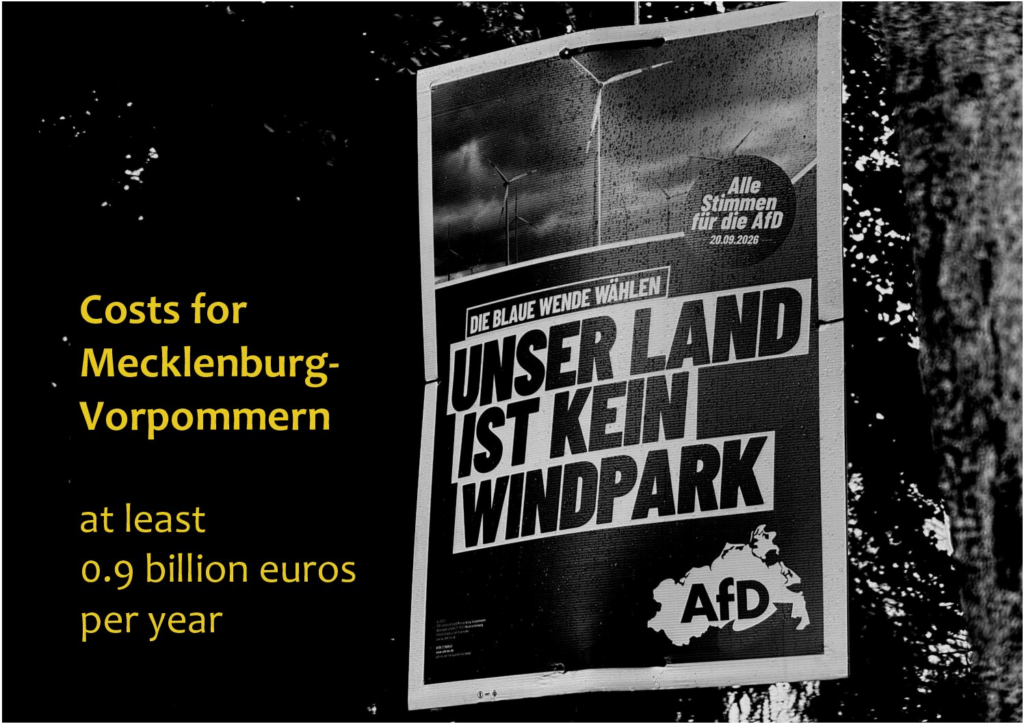
Ahead of the state elections in Saxony-Anhalt and Mecklenburg-Vorpommern in September 2026, the AfD, currently leading the polls, is making the dismantling of wind power a central campaign pledge—in the lee of similar demands from right-wing populists worldwide, foremost the current US administration. Under examination is the claim that wind power is unreliable, expensive and environmentally damaging, and that gas, nuclear power and biogas would be the better alternative. The finding: measured against the available figures, the indictment does not hold up, and the proposed replacement—chiefly Russian pipeline gas—would raise prices, weaken security of supply, and deepen import dependency.
Print this page: https://olters.eu/wp-content/uploads/2026/08/260817_Commentary_windmills.pdf
‘Look, your worship,’ said Sancho. ‘What we see there are not giants but windmills, and what seem to be their arms are the vanes that turned by the wind make the millstone go.’
— Miguel de Cervantes (1605/1615), Don Quixote, Part One, Chapter Eight. Translated by John Ormsby (1885).
Europe, migration — and now energy. With their ‘windmills of shame’, the far-right Alternative for Germany (AfD) party has opened a third front against the established parties. That is what the AfD’s co-leader and then candidate for chancellor, Alice Weidel, called the installations that generate more electricity in Germany than any other single source, at her party’s federal congress in Riesa, Saxony, in January 2025. ‘When we’re in power, we’ll tear down every wind turbine. Down with these windmills of shame!’ she declared, to applause from the delegates. On the evening news, she linked the remark to the planned wind farm in Reinhardswald, Hesse. At the same congress, Björn Höcke — the AfD’s leading figure in Thuringia, whose party branch there is officially classified as right-wing extremist — made no such qualifiers: Germany’s wind-industry installations, he said, would be dismantled ‘lawfully but completely.’ The party’s flagship motion at the congress called for an immediate end to the large-scale destruction of nature caused by wind and solar installations in forests, fields, and farmland.
None of this is a new position. As far back as the 2016 manifesto of principles, the party had demanded the abolition of the Renewable Energy Sources Act without replacement, branding it a ‘centrally planned economy’. What is new is what this rejection has become: not just the repeal of a law, but the demolition of existing installations, and not just a technical issue, but a key campaign issue in two state elections.
While the scope of the intended dismantling can be debated, the word ‘shame’ cannot. It reads as an echo of Björn Höcke’s Dresden speech in January 2017, in which he called Berlin’s Holocaust memorial a ‘monument of shame’. To ascribe a loss of honour to a technical installation that merely turns wind into electricity is not a statement of fact, but a political act. Shame implies guilt, and guilt presupposes a culprit. Anyone who speaks of generating plant in this way no longer sees plant. They see an enemy.
This summons the whole of European literary history, albeit unintentionally. Over four hundred years ago, a Spanish tax collector wrote about what happens when a man sees something other than windmills in a line of windmills. The outcome is well known, and it was not to the detriment of windmills.
In the ‘governing programmes’ of the Alternative for Germany (AfD) party for the state elections in Saxony-Anhalt on 6 September and Mecklenburg-Vorpommern on 20 September 2026, this provocation has become a government plan — albeit one whose energy policy is not actually decided in Schwerin or Magdeburg. The programme envisages the abolition of the Windenergieflächenbedarfsgesetz, a law that obliges federal states to designate a fixed proportion of their land for wind power; substantially tighter environmental impact assessments; and the immediate discontinuation of state-run citizens’ forums, which the AfD claims only create the appearance of democratic participation while actually pushing wind projects through against the will of the population. Of these three demands, the first is federal law and the second rests on EU law, and only the third would actually lie within a state’s own remit.
The allegations set out in the AfD’s Mecklenburg-Vorpommern ‘governing programme’ — which is more detailed than the Saxony-Anhalt document — can be distilled into three parts. This is followed by an equally explicit counter-project.
Unreliability. Wind power is argued to be unreliable because it only delivers when the wind blows. Dunkelflauten — periods of several days during which there is weak wind and low solar irradiation, characteristic of central European winters — make conventional power stations ‘indispensable as backup’. Therefore, wind power does not replace them; it makes them more essential to the system, which the AfD deems ‘nonsensical as energy policy’. The Saxony-Anhalt programme summarises this argument in a single sentence: during a Dunkelflaute, the supply of electricity ‘can only be maintained by ramping up coal- and gas-fired power stations.’
Cost. Wind energy, it claims, works only through state privilege, citing examples such as priority grid access, guaranteed feed-in tariffs and permanent subsidies. The true costs, however, are hidden: grid expansion across a large, sparsely populated state; reserve power plants; compensation for curtailed turbines; substations; and storage that does not yet exist on the required scale. All of this is paid for by citizens through taxes and levies, as well as through some of the highest electricity prices in any industrialised country.
Burdens without benefit. Industrial-scale build-out, the programme argues, fragments habitats, alters entire landscape silhouettes in a state that relies on tourism. It imposes noise, infrasound, shadow flicker and falling property values on local residents, while the profits ‘flow off to external investors and centres of consumption far outside Mecklenburg-Vorpommern’. Those who have the turbines on their doorstep get, according to this view, nothing from them.
The counter-project. What should come instead, the programme states with remarkable candour. Its long-term anchor is nuclear power: a ‘return to nuclear energy — proven and forward-looking’. In the meantime, it identifies three pillars: first, the operation of modern gas-fired power stations, ‘preferably using affordable pipeline gas as a flexible and efficient bridging fuel’; second, the ‘targeted use of electricity imports from neighbouring countries with nuclear and hydroelectric power’; and third, decentralised generation from biogas plants, which are ‘capable of baseload supply, regionally rooted’ and stand ‘in keeping with our state’s agricultural structure’. These three pillars are intended to provide the time needed for a responsible return to nuclear power — ‘without burdening the state with further wind turbines.’
This proposed return to coal, gas and nuclear power is taking place in the lee of thus-justified energy policies in the US. On 23 September 2025, US President Donald Trump told the 80th session of the United Nations General Assembly that climate change was the greatest hoax ever perpetrated on the world. He dismissed renewable energy as a joke. Wind turbines, he said, were so pathetic and so bad, so expensive to operate, and they had to be rebuilt all the time; they started to rust and rot. They were, in his view, the most expensive energy ever conceived. Most were built in China, he said, but they had very few wind farms: ‘So why is it that they build them and they send them all over the world? But they barely use them.’
Four months later, at the World Economic Forum in Davos, he labelled Europe’s wind turbines ‘losers’ and dismissed the officials and investors that purchase such installations as ‘stupid people’. He has repeated this sentiment on numerous occasions since then, most recently on 3 August in the Oval Office. He stated that any country with wind turbines was a loser because they were losing money.
Three days later, this became official budget policy. On 6 August 2026, RWE returned three offshore lease areas awarded by the US Department of the Interior — off New York, Humboldt County in California, and Louisiana — with a combined potential capacity of 7 gigawatts. In return, the company received US$1.22 billion. At the same time, RWE announced that it would invest the proceeds in fossil infrastructure, including around US$900 million in a liquefied natural gas project in Louisiana and a further US$300 million in gas turbines. This was the fifth agreement of its kind, bringing the total value of such agreements close to US$4 billion.
One cannot legislate the wind to be more expensive. However, one can pay for it not to be used. That is the pattern worth recognising. No one has tried to reverse the learning curve of module manufacturing or increase the cost of battery production; that would not work in any case. What is attacked instead is everything the price itself does not cover: permits, land, grids, capital, and cross-border co-operation. The fall in price is irrefutable. Construction is not.
Now for the figures: they are not seriously in dispute and come from the annual statistics. In 2025, wind power accounted for 8.5 per cent of the world’s electricity generation, reaching a record high of 2,715 terawatt-hours — an increase of 205 terawatt-hours on the previous year. Despite deployment falling 11 per cent short of the target, new wind capacity reached a record high of around 167 gigawatts. Together, wind and solar power supplied 17.3 per cent of global electricity — almost four times their combined share a decade earlier. For the first time, renewables overtook coal in global electricity generation.
Against the claim made by President Trump in New York, one statistic provides context. In 2025, China generated 1,135 terawatt-hours of wind power, accounting for 42 per cent of the world’s total output — surpassing the combined output of the G7 states. The country accounted for 68 per cent of the global increase in wind generation and 72 per cent of new capacity added. The claim that China builds wind turbines and does not use them is not a matter of interpretation. It is wrong, and wrong by a margin visible from orbit.
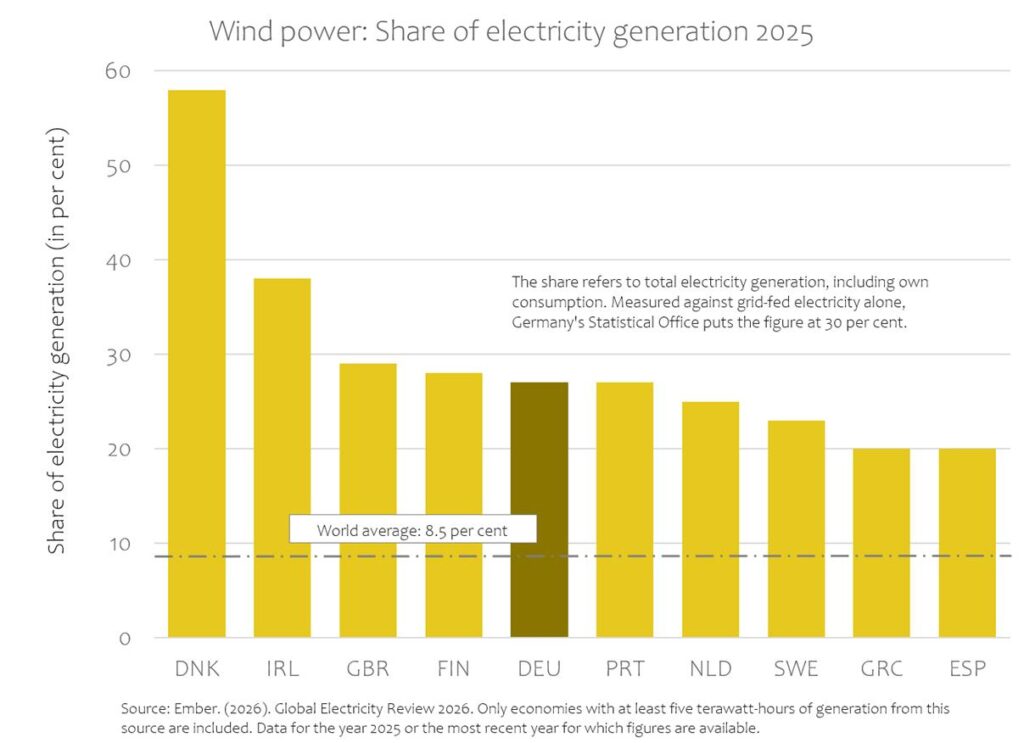
As for the charge that no serious country relies on wind power, a look at the ranking settles it. Among countries generating more than 5 terawatt-hours of wind power, the ten with the highest proportion are all in Europe. Denmark leads with 58 per cent, followed by Ireland on 38 and the United Kingdom on 29. Germany ranks fifth with 27 per cent (see figure). This threshold excludes countries such as Lithuania (39 per cent, on 4.8 terawatt-hours) and Uruguay (33 per cent, on 4.5 terawatt-hours). Worldwide, 15 countries now generate more than a fifth of their electricity from wind; in 2020, it was nine.
The picture looks different when ranked by absolute volume — and it is the more revealing one. In second place behind China comes the US with 464 terawatt-hours. Despite its president calling wind turbines ‘pathetic’ and declaring that any country with them is a ‘loser’, the US is the world’s second-largest generator of wind power. Germany follows in third place with 136 terawatt-hours.
In terms of cost, 91 per cent of all utility-scale renewable energy projects commissioned in 2024 produced electricity at a lower cost than the cheapest new fossil fuel alternative, even without subsidies. With an average cost of 3.4 US cents per kilowatt-hour worldwide, onshore wind was the cheapest new source of electricity generation globally. This is why deployment continues to advance even where there is no climate policy obligation whatsoever. In Texas, for example, the deregulated grid in this conservatively governed state simply pays for the cheapest megawatt-hour, and for years that has been wind-generated electricity. In 2025, Texas accounted for almost 28 per cent of American wind generation: 129.5 terawatt-hours — only slightly less than Germany’s total output that same year. This was achieved without a climate target, but not without subsidy: the state that tops America’s build-out statistics is governed by the party of the president who calls wind turbines pathetic.
In Saudi Arabia, the same calculation is made in terms of opportunity cost. The Kingdom burns around a third of its own production domestically — approximately 3.5 million out of 11 million barrels per day — and is systematically replacing this with gas and solar power as each unburned barrel generates a higher income on the world market. The programme to replace liquid fuels in power generation aims to eliminate the use of over a million barrels a day. However, production itself will not be affected, as the energy minister has stated that the country will monetise every molecule. This is not an energy transition. It is arbitrage.
Reports from the Federal Statistical Office contradict the US President’s comments at the UN, in which he praised Germany’s decision to return to fossil fuels and nuclear power. The reports state that, in 2025, renewable energy sources covered 58.6 per cent of net electricity generation. Wind was the largest single source and solar power exceeded lignite for the first time. Hence, this claim was false when it was made, as proven by Germany’s generation statistics.
The counter-project on offer deserves the same level of scrutiny.
Nuclear power. One could argue that it has a place in a decarbonised system — but not on grounds of competitiveness. It is neither the cheapest nor the fastest option for implementation. The West’s recent track record consists of projects that have been years late and billions over budget. Examples include Flamanville 3 (construction began in 2007, with the grid connection in 2024), Olkiluoto 3 (2005–2023) and Hinkley Point C (under construction since 2017). Another example is the Vogtle project in Georgia, where capital costs have risen from US$14 billion to US$36.8 billion — over two and a half times the original estimate. The economics of small modular reactors remain unproven.
The following simple arithmetic applies: a decision taken in 2026 would need to reverse the existing phase-out decision. A suitable site would need to be found. A licence would need to be granted. A willing operator would need to be found to take on the risk. Electricity would then be delivered in the 2040s. Therefore, the bridge is not a viable option. Over any politically relevant time horizon, gas and electricity imports do not constitute a transition to nuclear power. They are the policy itself. Nuclear power is the vanishing point that justifies them.
The European Union has indeed included nuclear power in its taxonomy as a climate-compatible investment, but only to a certain extent. Inclusion as a transitional activity came in 2022, subject to conditions including waste disposal plans and accident-tolerant fuel. The decision was fiercely contested among member states. Austria challenged the decision in the General Court of the European Union, but lost on 10 September 2025. The country then lodged an appeal against the ruling with the European Court of Justice in November 2025. Talk of a ‘growing global consensus’ is an assertion, not a finding. Nuclear power generation has stagnated for years, growing by an average of just 0.2 per cent annually between 2020 and 2024, whereas solar power grew by 25 per cent and wind power by 12 per cent. The share of global electricity generation from nuclear power has been in decline for decades, falling to 8.9 per cent by 2025, whereas wind and solar power together reached 17.3 per cent.
Electricity imports. The second pillar contradicts the initial accusation. A programme that criticises wind power for its dependency recommends importing electricity as a replacement — for a state that has generated more renewable electricity than it has consumed since 2015. Mecklenburg-Vorpommern is set to transition from a net producer to an importer in the name of independence. However, crossing a border creates a dependency that politics can sever. Wind blowing across a coastal state creates none.
Biogas. The third pillar of the programme contradicts its chapter on solar power. Ground-mounted photovoltaics are rejected on the grounds that high-quality farmland must not be diverted from food production: ‘Protecting land means protecting the homeland and the environment.’ However, growing energy crops for biogas plants permanently diverts large amounts of farmland from food production — already to a considerable extent in Mecklenburg-Vorpommern. While the same competition for land is a disadvantage for solar power, it is an advantage for biogas. This trade-off is not being considered. It is a choice being made.
A commentary that skips over the objections has proven nothing. So, one by one.
The Dunkelflaute. This objection is legitimate and not disputed: a system that relies heavily on wind and solar power requires additional firm capacity. This is not a concession to the AfD, but a fundamental truth of system planning. It is the implications that are contested. Technical literature suggests a staggered flexibility and storage stack organised by duration: batteries for the daily cycle (the cost of which has fallen by more than 90 per cent over the past 15 years); pumped storage and reservoir hydropower for periods ranging from hours to days; and hydrogen in caverns to bridge seasonal gaps. This would complement demand management, grid expansion and cross-border interconnectors. Each of these layers has its own limits, and the honest summary is this: clean energy is abundant on average, but expensive at the margin. This is a systemic issue, not an argument against generation. There is also a precondition that does not appear in the programme: grids and interconnectors. Those who oppose them exacerbate the very problem they complain about.
Infrasound. Precision matters, especially here. In 2005, Germany’s Federal Institute for Geosciences and Natural Resources (BGR) published a study which found that wind turbines produced infrasound levels of over 100 decibels. Researchers Stefan Holzheu and Martin Hundhausen, from the universities of Bayreuth and Erlangen respectively, spent years highlighting a calculation error in the study. Following a review by the National Metrology Institute (PTB) in 2021, the BGR conceded that its figures were 36 decibels too high. On the logarithmic scale, this equates to approximately four thousand times the actual sound power. The study was withdrawn, and the then economy minister apologised. For 16 years, a federal agency had been providing opponents of wind power with talking points.
What makes the episode so revealing is that the claim did not disappear along with its refutation. It is still being made. Note this fact; we shall return to it.
Birds and bats. The honest answer to this question has two parts. Firstly, consider the scale: NABU, Germany’s nature conservation association, estimates that around 100,000 birds die at wind turbines in Germany each year. For comparison, the same association estimates that up to 115 million birds die each year by flying into glass panes and mirrored façades, while tens of millions more are killed by domestic cats and road traffic. The difference is roughly three orders of magnitude. Anyone who uses bird protection as an argument against wind power while ignoring glass façades is not engaging in a nature conservation debate.
Secondly, it should be noted that absolute numbers are not everything. According to NABU, collisions with wind turbines disproportionately affect large birds of prey such as around 12,000 common buzzards and 1,500 red kites each year. These species have low population densities and slow reproduction rates, and they are hardly affected by glass. This is a genuine issue requiring genuine solutions, such as site selection, shutdown algorithms, anti-collision systems and curtailment periods for bats. It does not call for the abolition of area targets.
Rotor blades. The programme claims that composite rotor blades cannot be recycled, implying that this incurs an ecological debt to be inherited by future generations. However, the evidence is more nuanced. Around 90 per cent of a wind turbine, including materials such as concrete, steel and copper, is already recyclable, with blades accounting for just 5 per cent of a turbine’s weight. The German Bundestag’s Research Services estimate that properly decommissioned turbines can achieve a recycling rate of 81 per cent. A voluntary ban on landfilling rotor blades has been in place across the European wind industry since 1 January 2026. Processes for material recovery, such as pyrolysis and use as feedstock in cement works, already exist and produce secondary raw materials.
However, in January 2026, the Bundestag’s Office of Technology Assessment noted that there are no established industrial-scale pathways for material recovery and that Germany’s processing capacity is insufficient for future volumes. This is a problem of capacity and regulation, not physics. The claim ‘cannot be recycled’ was once defensible. It is no longer.
Decommissioning. Unlike any other form of energy generation, the decommissioning obligation and financial security requirements for wind turbines on undeveloped land are expressly regulated by German planning law; see Section 35(5), sentences 2 and 3, of the Federal Building Code. When using the end-of-life costs of a technology as a benchmark, it is also important to consider the costs of lignite opencast mines, power plant decommissioning and the final disposal of high-level radioactive waste. Regarding the latter, despite more than 60 years of civil operation in Germany, no final disposal site has yet been found. It is striking that a programme which leaves the dismantling of wind turbines to future generations should revert to a technology whose decommissioning timescale is measured in millennia.
Subsidies. The EEG surcharge was abolished in 2022. New wind projects are now awarded through competitive auctions, and the average clearing price has recently fallen. This has enabled the Federal Network Agency to reduce the maximum price. However, above all, the subsidy arithmetic cannot be conducted one-sidedly. According to the International Monetary Fund’s calculations, explicit subsidies for fossil fuels amounted to around US$725 billion worldwide in 2024. Taking into account the unpriced environmental and health damage caused by fossil fuels, the Fund arrives at a figure of around US$6.7 trillion. Those wanting to discuss permanent subsidies now have a topic to talk about — just not the one they had in mind.
The landscape. This is not something to argue over with numbers, and one should not try. That a wind farm changes the look of a landscape is true; that many people experience this as a loss is a fact politics is obliged to take seriously. But this loss has to be weighed against other changes to the landscape — against opencast mines, against power lines, against the coastline at 3 degrees of warming — and that weighing-up does not happen in the programme. It is replaced by the claim that there is an option involving no intervention at all. There is not.
The argument turns here, and it turns against those making it. In Europe, wholesale electricity markets operate according to the merit order principle, whereby the cheapest power stations are used first and the price is set by the most expensive power station required in that hour. In Germany, the conventional share of electricity supplied — net generation, or gross output minus power stations’ own consumption — still stood at 41.4 per cent in 2025. For as long as this remains true, a gas-fired power station regularly becomes the marginal plant in the evening and winter hours. The electricity price that German households complain about — and which is among the highest in Europe — is made up of procurement costs, distribution costs and margin, plus grid fees, taxes, levies and charges. Of these components, only procurement costs fluctuate within the year. When the price jumps, it is procurement costs that move. To a considerable extent, this component is the gas price. Everyone learnt what that means in 2022. When Russia throttled supplies to Europe, wholesale gas prices rose to a multiple of their historical level, and electricity prices followed, because gas was setting them. No wind turbine did that. No solar installation did that. The mechanism was a fuel that has to be bought from somebody, shipped from somewhere, and paid for at whatever price the seller can enforce in a crisis.
Wind and sun have no fuel bill. Their marginal costs are close to zero, and every hour in which they run is an hour in which no gas-fired power station sets the price. Their contribution to the electricity bill consists of capital and system costs; their contribution to the bill’s exposure to fuel prices and to foreign-policy blackmail is negative. They are the part of the system that cannot be embargoed, cannot be shut off at a compressor station, and cannot be repriced by a foreign government in the middle of a cold February.
The programme’s logic therefore runs backwards. A policy that reduces the wind share does not lower the price the AfD complains about. It increases the number of hours in which gas sets that price, and it increases the vulnerability of a country — and of a state — to precisely the kind of shock that produced the 2022 crisis.
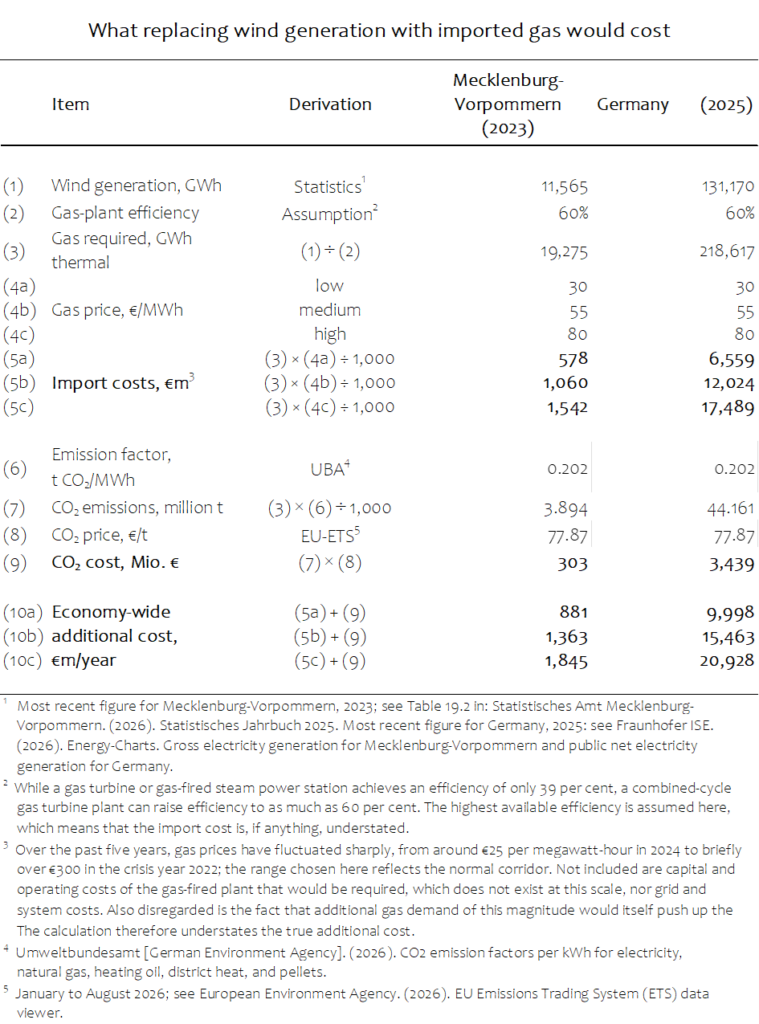
The order of magnitude can be expressed as a number. According to the latest figures available from the State Statistical Office, wind turbines in Mecklenburg-Vorpommern generated 11.6 terawatt-hours of electricity in 2023. Replacing this with gas-fired power stations would require around 19 terawatt-hours of natural gas, even with the most efficient technology available. Assuming an extremely favourable gas price of €30 per megawatt-hour, the import bill would total almost €600 million, plus an additional €300 million to offset around 3.9 million tonnes of CO₂ emissions. Based on the lowest available figure for German wind generation in 2025 (public net generation as reported by Fraunhofer ISE, which tends to understate the calculation), the nationwide figures would be close to €6.6 billion and 44 million tonnes, equating to an additional cost of around €10 billion altogether (see table). Year after year, this money leaves the country for a raw material that is available free of charge in Mecklenburg-Vorpommern, particularly along its Baltic coast. Partially replacing wind power with coal would increase the CO₂ bill even further.
There’s no need to guess. The programme says so itself. Under the heading ‘Nord Stream: secure and affordable energy through pipeline gas’, the programme refers to the pipeline as being integral to energy policy, describing it as an ‘anchor of economic stability’. It demands that ‘the still-intact Line B of Nord Stream 2’ be ‘brought into operation as quickly as possible’, and that the damaged lines be ‘repaired without delay’. The final sentence renders everything else superfluous: ‘Germany’s economic interests are to be safeguarded independently of the supplier country’s political system.’
With this, the AfD has come full circle. They criticised wind power for its dependency, yet the solution they propose is a pipeline to Russia. The accusation was that wind power was unreliable; the solution is a supplier that cut off Europe’s supply in 2022. The criticism was that wind power was driving up prices; the solution is a fuel whose price spike precisely drove up the very bills that the programme complains about.
Two further sentences deserve attention because they summarise the argument of this commentary in the words of its opponent. The first states that diversifying supply sources generally reduces dependency and protects against extreme price fluctuations. This is correct, and it explains why renewable energy generation should be expanded to the point where the need for a supplier is eliminated altogether. The second states that protecting German infrastructure and asserting German interests are non-negotiable. This directly supports the demand to resume supply from the state whose cut-off triggered the 2022 crisis.
In legal terms, the demand is moot in any case. No state parliament decides on gas imports, and Regulation (EU) 2026/261, agreed between the Council and Parliament in December 2025, which entered into force in February 2026, phases out Russian pipeline gas by the end of September 2027 — in narrowly defined exceptional cases, by early November 2027. What is being promised here cannot be delivered in Schwerin.
Both pillars of this programme are located in Mecklenburg-Vorpommern at the same address. The Nord Stream 1 and 2 pipelines come ashore at Lubmin, just 2 kilometres from the Greifswald nuclear power station. The station has been shut down since 1990 and has been undergoing decommissioning ever since. The pipelines are idle, the reactor is being dismantled and the regasification vessel that supplied gas for only 15 months has long since been towed away. The future that this programme promises is already the present in Lubmin, with a bill of the kind that the above table lets one foresee.
This raises the real question: every kilowatt-hour not generated from wind is a kilowatt-hour that has to be bought, as fuel, from somebody who sells fuel. The world’s oil and gas producers have lost pricing power over the past decade — not to a contract, but to a cost curve. Whatever holds back that cost curve hands it back to them.
This need not be a claim about any party’s intentions, and none is being made here. It is a statement about effects, and effects can be read off a balance sheet. When the US Department of the Interior pays RWE US$1.22 billion to give up 7 gigawatts of offshore wind, and RWE invests the proceeds in liquefied natural gas, that transaction has a beneficiary, and it is not the American electricity customer. Under the transatlantic trade agreement, the European Union has, at the same time, committed to sourcing substantial volumes of energy from the United States over three years. And when Mecklenburg-Vorpommern is called upon to abolish its area obligation and rely instead on Russian pipeline gas, the resulting gap will not be filled by nothing.
Opposition to wind power and the demand for Russian gas do not sit side by side in this programme by accident. They are the same policy, described from two sides.
This raises the question of how the broader Energiewende — the actual target of the attack on the wind turbines — is really faring. According to the most recent figures from the State Statistical Office, renewables accounted for almost 88 per cent of gross electricity generation in the coastal state of Mecklenburg-Vorpommern in 2023 — the highest proportion of any German state and around one and a half times the national average. Hard coal and natural gas together still contributed just under 12 per cent. Wind power alone supplied 11.6 of the state’s total 19.1 terawatt-hours, accounting for over 60 per cent of the state’s total electricity generation — exceeding the contribution of gas-fired power stations by a factor of ten. The state has been a net producer since 2015, generating more renewable electricity than it consumes. This is not a burden imposed on the state. Rather, it is the most successful expansion of generating capacity since reunification.
And the expansion is not slowing down. In 2025, 78,674 renewable installations in Mecklenburg-Vorpommern fed a combined total of 11,179 megawatts into the grid — around 14,000 more installations than the previous year, almost all of which were solar. The installed capacity of these solar installations is now approaching that of wind power, at 4,990 and 5,738 megawatts respectively. Nationwide, 2025 was the best permitting year in German history, with 20,765 megawatts of newly approved capacity and an average permitting time of 17.0 months, down from 23.2 months. Auctions are oversubscribed, average clearing prices are falling, and the Federal Network Agency has lowered its ceiling price in response. Competition is working.
The bottleneck is located downstream of the generator. Grids are not keeping pace with generation, so grid connection rather than permitting is now the bottleneck. Storage on the required scale is only now emerging. There is a stark difference between the north and south: 54 per cent of all wind capacity approved since 2013 was allocated to Lower Saxony, Schleswig-Holstein, and North Rhine-Westphalia, compared to just 8 per cent for Bavaria and Baden-Württemberg combined, despite them having a greater land area and lower population density.
Notably, not a single wind turbine appears on this list. The Energiewende is not being held back by generation. It is everything that the price signal does not carry by itself — precisely the level at which political attacks are launched, as the American ‘lee’ has shown. Abolishing area targets will not speed up grid expansion. It removes the one thing that is already working.
The cost arithmetic does not add up either. The programme lists compensation for curtailed installations as one of the hidden cost drivers. The Federal Network Agency has published figures for 2025, showing that the total cost of grid congestion management was around €3.1 billion. Of that, €433 million was spent on compensation for curtailed wind and solar installations. The largest components were conventional redispatch, at over €1.2 billion, and reserve power stations, at €1.4 billion — fossil fuel power stations, in other words. Only 3.5 per cent of renewable generation was curtailed, with over 96 per cent reaching the grid. Costs peaked in 2022, when expensive gas generation increased in the south while cheap wind generation stood idle in the north. The redispatch bill rises with the gas price. This is an argument for expanding the grid, not reducing wind capacity.
Until and including 2024, the regions that generated electricity for the whole of Germany paid the highest grid fees. The costs of grid conversion were incurred where the turbines were located, while the electricity was consumed elsewhere. This was unfair and measurable, but has now been rectified: since 1 January 2025, these additional costs have been shared nationwide. In the WEMAG network area in Mecklenburg-Vorpommern, household grid fees fell by almost 40 per cent — more than €200 a year — while in the E.DIS area, they fell by around a fifth. For years, the state government in Schwerin had been demanding this reform.
The second part of the criticism — that profits are made while local residents receive nothing — is even less applicable to Mecklenburg-Vorpommern, a fact of which the state can be proud. Since 28 May 2016, the state’s Bürger- und Gemeindenbeteiligungsgesetz has required anyone building a wind farm to set up a dedicated project company and offer at least 20 per cent of its shares to local residents and municipalities within a 5-kilometre radius at a price of no more than €500 per share. The Federal Constitutional Court upheld the law, in substance, in 2022. In March 2026, the state parliament amended the law, giving municipalities more room to negotiate and extending its scope to include solar parks. Mecklenburg-Vorpommern broke new ground nationally with this law, and other states have since followed suit.
It is imperfect — agreements were not reached in every case, which prompted the amendment. However, the claim that those with turbines on their doorstep receive nothing from them has been refuted by state law for ten years, upheld by the country’s highest court, and renewed just months before the governing programme was drafted.
These three elements are key to the success of the Energiewende: grids and storage that keep pace with generation, which is already growing; a burden-sharing arrangement between regions that has been in place since 2025; and a stake for those who bear the local burden of the country’s overall consumption. Two of these three conditions are met, or are on their way to being met. Abolishing area targets does not advance any of them.
A fourth condition is rarely mentioned alongside the others because it belongs to foreign economic policy rather than energy policy. In the current geopolitical situation, every kilowatt-hour generated domestically also represents de-risking, as it does not need to be ordered, shipped or piped in, nor purchased from a supplier whose interests may conflict with one’s own. The share of Russian gas in EU imports fell from around 45 per cent before the invasion of Ukraine to 19 per cent in 2024, and is estimated to fall further to 13 per cent in 2025. In December 2025, the Council and Parliament definitively decided to phase out LNG by the end of 2026 and pipeline gas by the end of September 2027. This was not a climate policy decision. It was a foreign policy decision, and renewable energy generation made it affordable in the first place.
The energy strategy has effectively become part of the broader foreign economic policy framework. As it is independent of supply relationships, it is the only element of supply security that cannot be exploited by foreign governments. Those who impede progress forego not only cheap electricity, but also lose freedom of manoeuvre in foreign policy, becoming dependent on other countries instead. The governing programme explicitly states that the political system of the supplier country should play no part in the matter.
Although it is quoted far less often than the attack on the windmills, there is a passage in Don Quixote that is more instructive. The lance lies in splinters. Horse and rider lie in the dust. Sancho points out, not unreasonably, that he had said from the outset that they were just windmills. Don Quixote replies: ‘[…] Moreover I think, and it is the truth, that that same sage Frestón who carried off my study and books, has turned these giants into mills in order to rob me of the glory of vanquishing them, such is the enmity he bears me.’ Frestón is not a new invention. He had already been used shortly before to explain the disappearance of a library, which the priest and the barber had actually burned. The magician is not invented when the refutation arrives — he is reused. This is a Frestonian procedure.
This illustrates the structure of the argument under review. This conviction does not survive because it is true. Rather, it survives because it provides an explanation for its own refutation. Even when wind and solar power are revealed to be the cheapest new source of electricity on Earth, the belief that they are ruinously expensive does not waver. Instead, the figures are accused of concealing the true costs; it is claimed that system costs are never reflected in electricity prices and that statistics have been fabricated by interested parties. This is essentially what the Mecklenburg-Vorpommern programme says.
That this is not merely a literary analogy is shown by four episodes, each one a matter of record.
Four refutations, no revision — and four Frestonian explanations for why they do not count. The difference between an argument and a trick performed by a magician is that an argument specifies what would disprove it. It is worth spelling that out precisely. This commentary would be wrong and the programmes right if: the global wind share were falling instead of standing at a record high; China were building turbines for export while barely operating any in its own grid; new fossil capacity were cheaper than new renewables; or the 2022 price shock had come from wind rather than a gas pipeline. None of these things are the case, and every single point can be verified within the hour using a published source.
And yet it would be its own kind of magic to pretend that these four refutations settle everything.
A share in the returns cannot replace an unbroken horizon. A lower grid fee does not eliminate shadow flicker. Participation offers did not come about in every case, as the 2026 amendment itself acknowledges. The core of the third charge remains: in any transformation, the gains are dispersed and the losses concentrated. Those who leave the balancing of this to chance create the very grievances that can then be organised. The fact that Mecklenburg-Vorpommern began regulating this balance earlier than anywhere else does not make the task any easier. It merely demonstrates that it can be resolved.
One policy recommendation follows from this, and it is not to build less: rather, it is to enhance participation, accelerate grid expansion and maintain the burden-sharing arrangement — in short, to reinforce the measures that address the grievance rather than eliminate those that did not cause it.
This is precisely where the quixotic element lies. Don Quixote was not mistaken in thinking that the windmills were dangerous; after all, their vanes shattered his lance and threw him to the ground. However, his error lay in his inability to see what he was actually fighting, and in the fact that the damage he caused was, for that reason, entirely his own. Here, it is different. The giant is an illusion, but the grievance that caused people to perceive it is not. This attack will result in greater price volatility, vulnerability to the next supply crisis and the return of pricing power to fuel sellers. The bill will be presented to the households whose names were used to couch the lance.
Jan-Peter Olters


 powered by Borlabs Cookie