
End of multilateralism? Great powers are reverting to the divide-and-rule technique of power politics practised by Caesar and the empires of the 19th century. Engaging with other powers individually—both allies and rivals—serves narrow nationalist agendas in a realist world and facilitates the zero-sum pursuit of spheres of influence.
Washington is employing tariffs, maps, threats, and bilateral agreements. Beijing negotiates market access and connectivity on a case-by-case basis. Meanwhile, Moscow has sought to accelerate the transition to a post-multilateral world order by proposing a three-way summit with Washington and Beijing to discuss the future of Ukraine. In Davos earlier this year, Mark Carney offered a response for the middle powers of the non-American West when he warned that if you were not at the table, you were on the menu. He was heard. At the EU–Canada summit in Montreal on 29–30 October, the EU’s offer of associate membership will be the first test of whether this insight can be translated into policy and ultimately into the lasting institutions of the emerging world order.
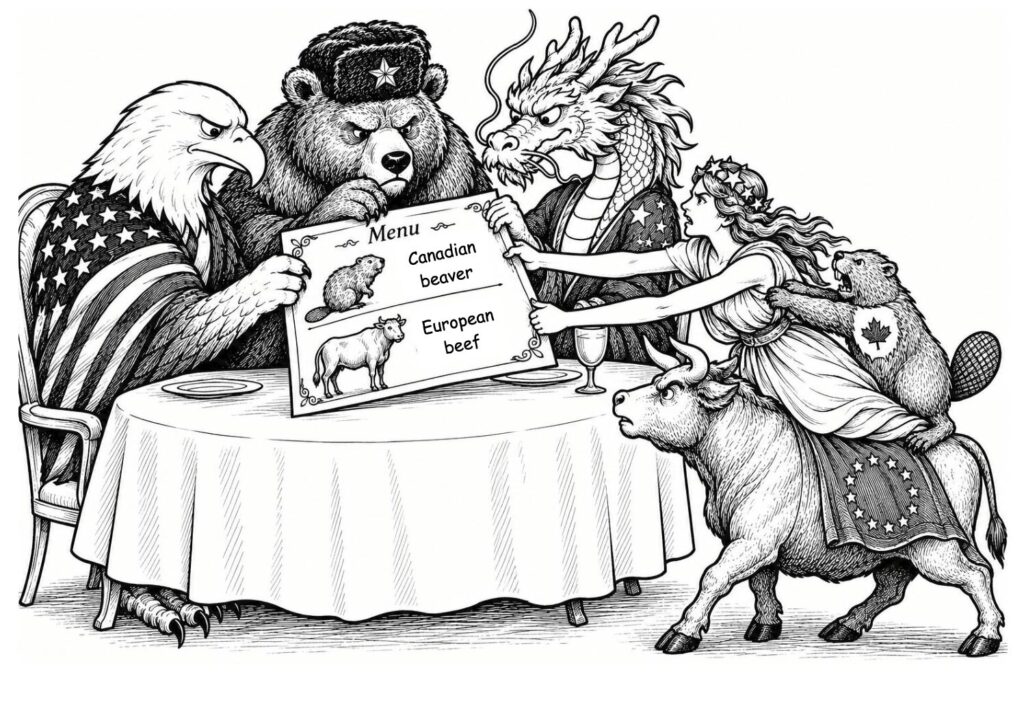
Published on the eve of the Montréal summit, the op-ed in Le Devoir, ‘Ensemble devant la table des grands’, sets out what this would require. Both the EU and Canada would face hard choices, even when abstracting from the risk of US retaliation. Ottawa would have to accept common rules; Europeans would have to commit to defending Canada without going through Washington.
The op-ed distils OPWP № 2026/02, ‘Réserver une place à table’, which extends shelter theory to the North Atlantic. Its proposal is to unbundle the EU’s security guarantee through a defensive mutual-assistance treaty. That treaty would be concluded outside EU law, modelled on Article 42(7) TEU, and open to the European members of NATO and Canada. Around an intact EU core, it would form the second ring of a security structure, alongside a parallel, concentric structure for integration.
The broader argument builds on three earlier pieces. ‘Europe’s Fight for Independence’ (September 2025) called for a layered membership architecture: variable geometry with structure, rather than Europe à la carte. ‘2026: Year One of a Post-Idealist Order?’ (December 2025) read renewed US claims on Greenland and Canada as signals of strategic reorientation rather than rhetorical excess, within a divide-and-rule logic in which Washington and Moscow reinforce each other and Beijing stands to gain. ‘A China Strategy for the Middle Powers’ (CORIM, April 2026) warned that, without common instruments, the non-American West would be treated as little more than an aggregate of markets.
Read together, the five texts make one case: middle powers gain a voice only when they act together—whether facing Washington, Beijing, or Moscow—and when they use moments of rupture to build institutions that last. Whether 2026 becomes ‘Year One’ of a post-idealist order, or the year in which it was contained, will depend on such institutions to be drawn up in Montréal.
Read the article in Le Devoir: Libre opinion | Ensemble devant la table des grands au Sommet Canada-Union européenne | Le Devoir


 powered by Borlabs Cookie